CPD – Post-Separation
Untangling Post-Separation Credits & Occupation Rent
How do we make sense of the chaos and address these issues proactively?
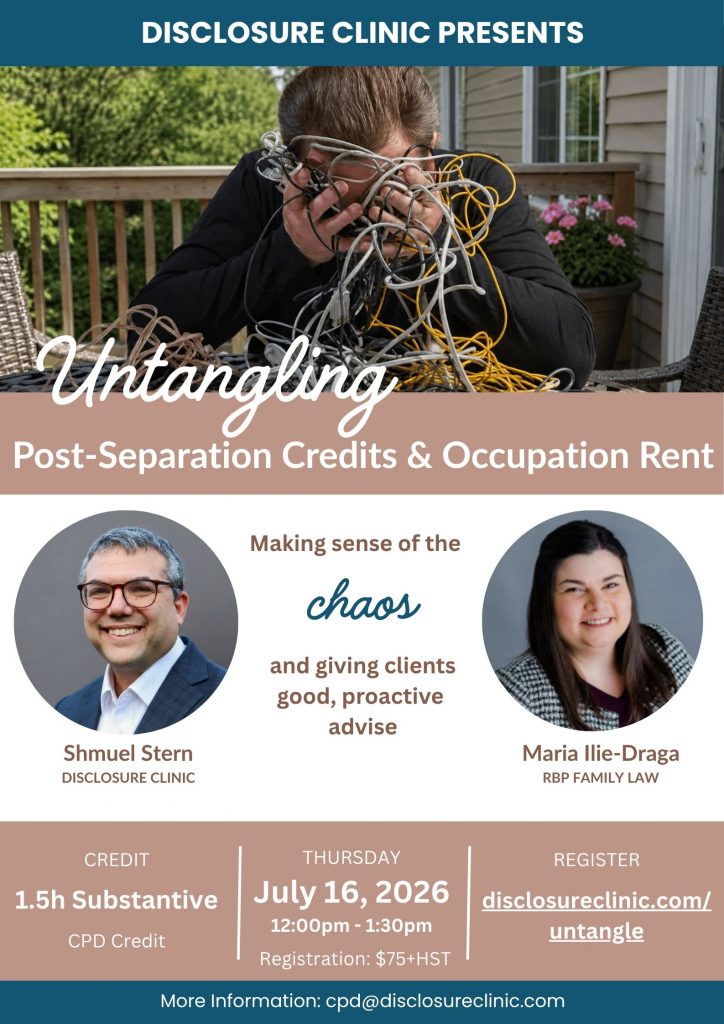
Too often, the “post-separation” period of a file takes on a life of its own, more complicated to resolve than determining the rights that accrued during the relationship. This practical CPD is designed for lawyers who want more than a review of the caselaw: to know how to get a handle of these issues proactively, what to tell your client, when to pursue granular calculations vs “rough justice”. Using the facts of actual court decisions as examples, you’ll learn a pragmatic framework for assessing claims, gathering the right evidence, and advising clients strategically from the outset.
Post-separation credits are among the most misunderstood and inconsistently plead claims in family law. The math can get confusing, especially where there are multiple interim “without prejudice” withdrawals from joint proceeds. We’ll look at the typical claims and more importantly, how to calculate and present them.
Occupation rent is no longer “exceptional”, but it remains very much discretionary. The better question is: What do we tell clients about payment on the house, whether they are in it or not. Spoiler: There may not be any ‘correct’ answers, but we should have a better sense on how occupation rent interacts with all the other post-separation claims. You’ll leave with practical guidance on advising clients who remain in the matrimonial home or who move out, helping them understand the financial consequences of their decisions and allowing you to proactively manage expectations, settlement discussions, and litigation strategy.
Participants will receive practical tools and learn how to:
- Understand the legal principles and equitable considerations underpinning both claims
- Identify viable post-separation credit claims at the first client meeting
- Recognize when to plead occupation rent to avoid future amendments
- Distinguish shared, recoverable expenses
- Advise clients on the documentation they should preserve immediately after separation
- Avoid common strategic mistakes that weaken otherwise legitimate claims
- Create practical calculation worksheets for calculating post-separation credits
And we want your questions to incorporate in the discussion if you have them. Just email: cpd@disclosureclinic.com
About this CPD Program
Details:
- Program Date: Thursday July 16, 2026 @ 12:00 p.m. – 1:30 p.m. EST
- Format: Zoom
- Created for: Family Law lawyers, mediators/arbitrators, judges, articling/LPP students
- CPD: Eligible for 1.5 hours of LSO Substantive CPD credits.
- Recording: A recording of the session is provided to registrants
- Materials: Materials are provided
- Cost: $75.00+HST per registrant (10% discount for 3+ registrants)
Presenters:
Shmuel Stern, family law lawyer and founder of Disclosure Clinic, an innovative limited scope service assisting litigants, lawyers, and mediators confronted with all issues touching family law financial disclosure. Shmuel created the Court Calculator, runs the @corollaryrelief Twitter feed and more recently is website editor of courtnoticefinder.ca. In addition to Disclosure Clinic, Shmuel practices family law in Ohio where he was called in 2021, and is trying to piece together what each jurisdiction can learn from the other.
Maria Ilie-Draga, family law lawyer practicing at RBP Family Law in Ottawa. Maria has experience in criminal law and high-conflict family law disputes, and assists with clients in English, French and Romanian. Her approach to post-separation issues is to try to get ahead of the issue as possible, including assessing the other side’s position before they raise it, and determining the likely outcome of the client’s overall situation to minimize the post-separation period as possible.
___________________________
Register Here